Family life
Carry It Together
When I was seven, I watched a superhero save the world by flying into danger while everyone he loved stood safely on the ground. When I was nine, I watched a princess give up her voice for a prince. When I was thirteen, I slowly watched my mom fall apart.
When I was twenty, she died. My sister Lida was seventeen.
I think somewhere in those years I decided: if I couldn't save her, I would save everyone else.
I don't remember much about the immediate aftermath — grief does that, it just blanks things out. But I remember one moment with absolute clarity.
I was at work, weeks after we said goodbye to her. I was working in customer service, and a woman came in — she was in her sixties — and she started talking about her mother. Her ninety-five-year-old mother had just died. She was devastated, venting, crying. She got to have all her feelings, completely uncensored.
And I remember thinking: her mom was ninety-five. She got to watch her get married. She got to see her have kids, grandkids. She got decades.
My mother was forty-five. I was twenty. Lida was seventeen. We got nothing.
But I couldn't say that. I couldn't fall apart. So instead I adjusted her glasses with a big smile on my face and I encouraged her through her grief — while I was dying inside, tears in a bucket I couldn't open.
That's the moment it really locked in for me: I don't get to fall apart anymore. I don't get to need anything. I need to be the strong one, because Lida is still seventeen and everyone else is falling apart and someone has to hold it.
I went to work and put on a smile. I went home and took care of Lida. I made decisions I wasn't ready to make. I became the adult in the room because there was no other adult there.
I got good at carrying everything alone.
And that became who I was, for years. The stories we grew up with were never really about the hero's strength. They were about self-sacrifice. Batman, Superman, Wonder Woman: all of them neglect their own lives, their own happiness, their own needs, to save everyone else. And we absorbed this as virtue. We learned that being good meant being available. That being worthy meant being useful. That being loved meant being needed.
My worth was in my usefulness. My safety was in being indispensable.
The thing nobody tells you is that the superhero is miserable. That's not shown on screen. Batman doesn't have a scene where he realizes he hasn't eaten since Tuesday. Superman never stops and thinks, what do I actually want? They're too busy saving everyone else to know.
When I met Jurie, I brought this wound with me like a suitcase I'd learned to carry so well I didn't even notice it anymore.
Every time he would come to help me, I had to prove how independent and strong and capable I was. I wouldn't let him help. I wouldn't ask for much. I would do it all myself — the groceries, the decisions, the emotional labor, the heavy lifting. All of it. Because if I needed him, if I depended on him, that meant I was weak. That meant I was back at twenty, with the weight of everything on my shoulders.
I couldn't go back to that. So I just kept carrying it all.
And Jurie loved me anyway — but he was watching me strain under the weight of something I wouldn't even name. He was watching me refuse his help out of pride or fear or both, and he didn't know how to bridge that gap.
Then one day his mom — Ma Estelle — sat down with me and said something I still think about all the time:
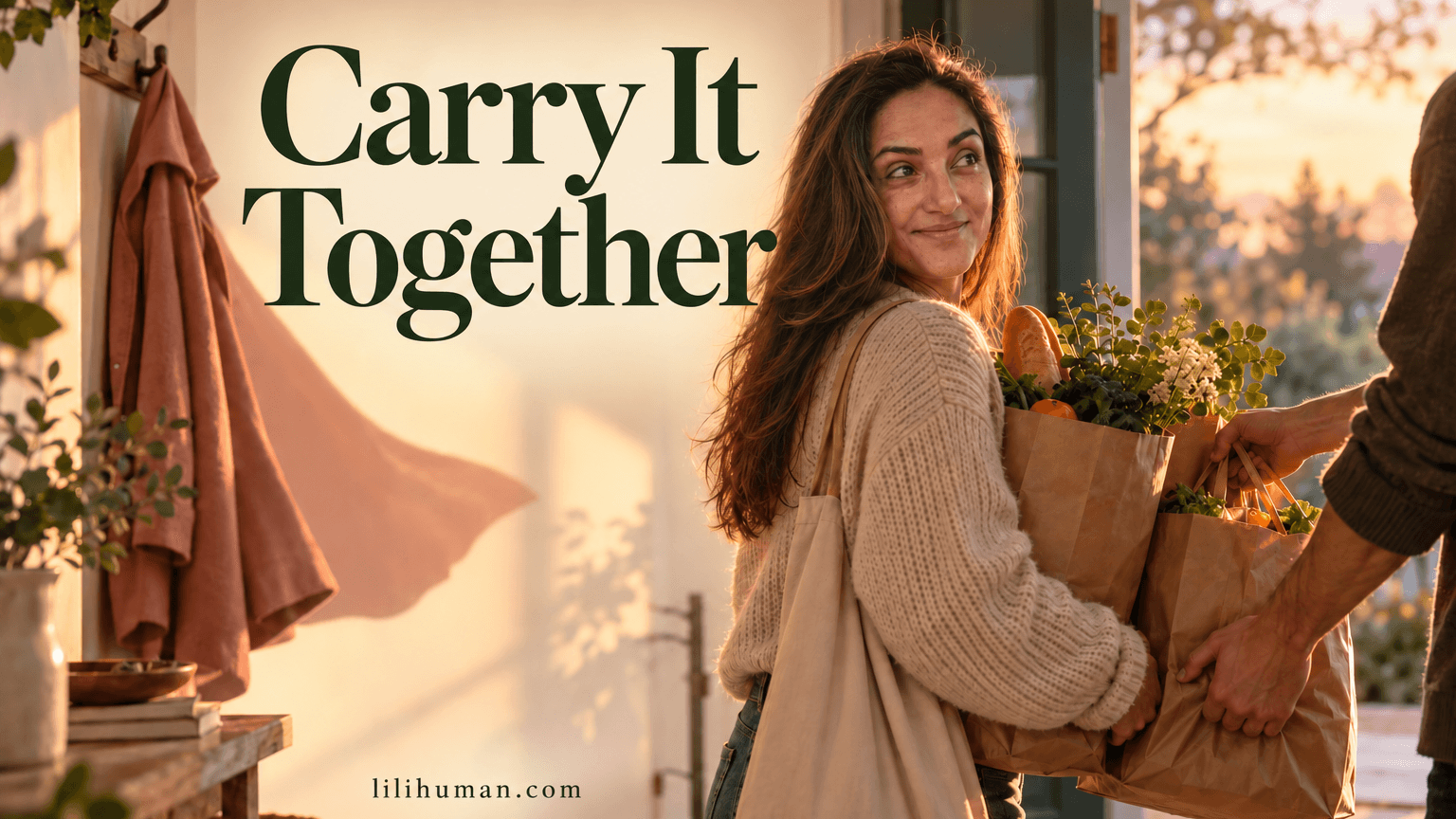
"I know you are very independent and have had to only rely on yourself. But have you thought about allowing someone to also pitch in and help you? For example, if you buy groceries, instead of carrying all the bags yourself, maybe give a few of the heavy ones to Jurie, and you can carry the weight of it together rather than all alone."
I remember being so struck by that. Not because it was complicated — it wasn't. But because nobody had ever given me permission to not carry it alone before.
I'd spent twenty years believing that needing help was the same as being weak. That asking for help meant you'd failed. That being the strong one was the only way to be safe.
Ma Estelle was saying something else entirely: You don't have to earn your place here by being invincible. You can just be human. And when you're human, sometimes you need someone to carry some of the bags.
A few months ago, someone asked me: "If you listened to yourself the way you listen to your friends, what would you say?"
I had to sit with that for a long time. Because when a friend spirals, I say, You're human. You're learning. Be gentle with yourself. When I spiral, I say: You should be doing more. I don't treat myself like a friend. I treat myself like someone who owes me a debt.
Here's what I'm learning: being a hero doesn't require saving everyone. It requires not abandoning yourself to try. That doesn't make you selfish. It makes you available — really available. Because when you're running on fumes, you can't actually see the people you're trying to save. You're too busy being the hero to be present.
Lida is an adult now. She doesn't need me to be her hero anymore — and honestly, I'm not sure she ever did. I think she just needed her sister. But I didn't know how to be just a sister. I only knew how to be strong.
I'm learning this slowly. Some days I slip right back into hero mode — the place where my needs get small and quiet and everyone else's get my full attention. But there's a moment now, when it happens, where something in me says: Wait. This isn't required anymore. You're allowed to be a regular person.
For a long time, I thought that not being able to save my mother meant I had to spend the rest of my life saving everyone else — like there was some cosmic debt to pay back.
But she wouldn't want this. She wouldn't want me small. She wouldn't want me exhausted. She wouldn't want me to have learned from her death that the only thing I'm worth is what I can give.
Lida and I are sisters now, not caretaker and dependent. We both survived it. And maybe the most heroic thing I can do is stop trying to save everyone and just be present with the people I love.
The bags are lighter when you're carrying them together.